
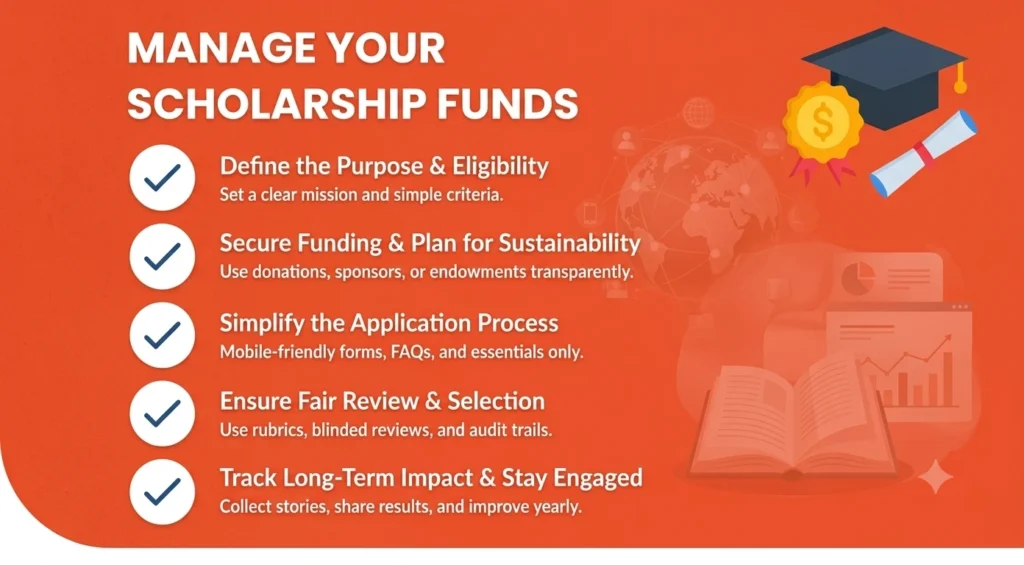
Someone asked me last month how to create a scholarship fund, and honestly my first thought was “isn’t that a rich-person thing?” It’s not, by the way. That’s basically the whole reason I’m writing this down. Her uncle had passed away, taught high school chemistry for thirty-some years, and she wanted his name attached to something that actually helped kids instead of just a plaque somewhere nobody reads.
Turns out you don’t need a fortune. You don’t need a law degree either, though it helps to at least know someone who has one. Also Read What Is a Merit-Based Scholarship?
Table of Contents
First, decide what you’re actually building
There’s a fork in the road early on. You can go fully independent – your own scholarship, your own rules, your own everything – or you can piggyback on an organization that already does this stuff, like a community foundation or a college’s existing scholarship office.
I’ll be honest, most people end up going with the second option. Not because independence is bad, but because setting up your own thing from scratch means paperwork, possibly a nonprofit filing, and someone (probably you) managing it forever. Partnering with a foundation means you write a check, hand over your criteria, and they run point on applications, vetting, and actually cutting the checks to winners.
Who’s it for, really
This is where people either nail it or completely stall out. Kids from a specific town? Students in a certain major – nursing, engineering, whatever fits your own story? First-gen college students? Student athletes at one particular school?
Get specific. Vague criteria like “must show financial need” describes basically every scholarship that’s ever existed, and it makes the whole thing feel generic even if your intentions weren’t. Also Read How Do Scholarships Work? A Real-World Breakdown
The money question everyone’s actually stuck on
Here’s the part nobody says out loud when they’re figuring out how to create a scholarship fund – you can start small. A few thousand dollars, a couple hundred bucks per winner, done. That’s a real scholarship.
Or you go bigger with something called an endowed fund, where a larger sum gets invested and only the interest gets handed out each year. The upside there is the fund basically never runs dry, assuming the investments hold up. The downside is you need real money up front to make it worth doing, usually tens of thousands at minimum before the interest amounts to anything.
Most community foundations will run these numbers with you for free, before you sign anything. Worth asking.
Criteria and applications
GPA cutoff or no cutoff? Essay or no essay? Recommendation letters, transcripts, proof of income – pick what actually matters to your goals and drop the rest. I’ve seen scholarships that ask for a single paragraph and a transcript. I’ve also seen ones that want a full packet like you’re applying to grad school. Neither is wrong, but know which one you’re building, because reviewing fifty applications with no clear ranking system later is genuinely miserable.
Legal stuff, briefly
Going independent usually means either forming a nonprofit or working through something called a fiscal sponsor, so donations stay tax-deductible. Talk to an accountant or lawyer here – seriously, don’t wing this part. It’s the one step where a mistake actually costs money later.
Partnering with a foundation skips most of this since they already have the legal structure sorted. It’s a big reason so many first-timers go that route.
Tell people it exists
A scholarship nobody knows about might as well not exist. Reach out to school counselors, financial aid offices, local community centers, whatever group touches the students you’re trying to reach. This step gets skipped constantly and it’s honestly the easiest one to actually do well.
Someone has to run it
Applications don’t review themselves. Decide early who’s picking winners each year – you, a small committee of friends or family, or the foundation handling it as part of the partnership. This matters more once the initial excitement of launching wears off and it’s just another yearly task. Also Read Do D3 Schools Give Athletic Scholarships?

So, how to create a scholarship fund, really
Pick who you’re helping. Figure out how much you can actually give and whether that’s a one-time thing or something built to last decades. Decide independent versus partnered. Sort out who runs the thing going forward. That’s genuinely most of it. The hardest part isn’t any single step – it’s just starting, since most people who think about doing this never actually get past the thinking stage.