Somewhere in every graduating class, there’s a student who paid nothing. Not for tuition, not for the dorm room, not even for textbooks—and sometimes there’s a bit left over for a laptop or a flight home for winter break. It sounds made up until you actually meet someone it happened to.
How do you get a full ride scholarship? It’s one of the most common questions students and parents ask during the college application process. Full ride scholarships aren’t a myth. But they’re uncommon enough that most families finish the entire college process without ever crossing paths with one, and that gap is exactly where bad assumptions creep in. People start believing you need a genius SAT score, a parent who coached Division I basketball, or some inside connection to a foundation nobody’s ever heard of.
Turns out that’s mostly wrong.
Landing one usually has nothing to do with luck. It comes down to starting the search early, understanding where this money actually comes from, and dodging a handful of mistakes that quietly knock strong applicants out of the running year after year. Also Read What Is a Merit-Based Scholarship?
Table of Contents
First, What Counts as a Full Ride
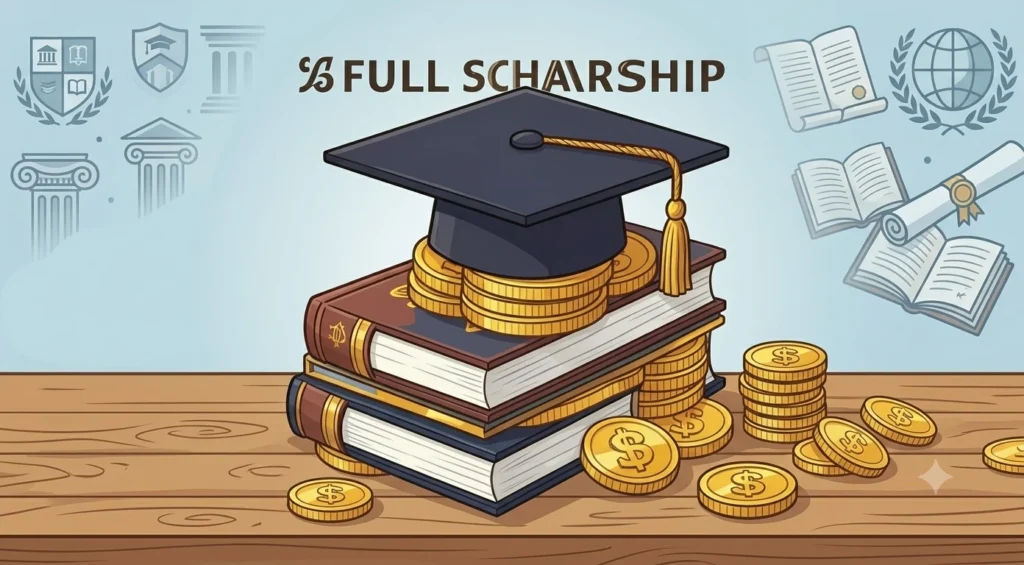
Worth sorting this out before anything else, because the term gets thrown around loosely. A genuine full ride pays for tuition, fees, housing, and food sometimes books, occasionally a stipend for everyday expenses. Some renew automatically across four years. Others require hitting a specific GPA every single term to hang onto the money.
Here’s the mix-up that trips people constantly: a “full tuition” award is not a full ride. Tuition-only scholarships leave housing and meals entirely on the family, and at a private university, that gap can easily run $18,000 or more per year. Read the award letter closely before assuming it covers everything.
Where This Kind of Money Actually Comes From
There are basically four sources, and each behaves differently.
Universities give out the bulk of full rides themselves, usually woven into the admissions process. Schools like Vanderbilt, Duke, and the University of Alabama run named merit scholarships that cover the whole cost of attendance for their strongest applicants. Public flagship universities do this too, especially for high-achieving in-state students it’s part recruitment, part reward.
Private foundations make up the second category. Groups like the Coca-Cola Scholars Foundation, the Elks National Foundation, and QuestBridge tend to be need-based or built around a specific mission — first-generation college students, a particular career interest, a specific community. Matching your background to the right foundation matters more than applying to every name you find in a search.
ROTC scholarships work differently altogether. Tuition and fees get covered in exchange for a service commitment once you graduate. It’s not the right fit for every student, but for those open to it, the competition is far less brutal than what you’d find chasing a merit scholarship at an elite university.
Athletics get more credit than they deserve here. Full athletic scholarships mostly live in football and basketball at the Division I level the so-called head-count sports. In almost every other sport, coaches are dividing a limited pool of scholarship money across an entire team. A gifted swimmer or volleyball recruit might land a solid partial scholarship. Rarely does it stretch into a full ride. Also Read Is ScholarshipOwl Legit? Here’s the Honest Truth
Academics Still Carry the Most Weight
Nobody loves hearing this, but grades and coursework remain the biggest factor in most full ride decisions, particularly the ones colleges award directly.
That doesn’t mean a perfect transcript. It means consistency, and it means challenging yourself. A B+ in AP Biology tends to impress an admissions committee more than an A in a class everyone knows is easy. They’re looking for students who pushed themselves rather than protected their GPA.
Standardized testing has become murkier since so many schools dropped requirements. But test-optional doesn’t always mean test-irrelevant plenty of merit scholarship formulas still lean on score thresholds even at schools that no longer require scores for regular admission. The only way to know for sure is checking each school’s scholarship page directly, rather than guessing.
The Essay Usually Decides Who Wins
Once a student makes it into the finalist pool for a competitive scholarship, grades stop being the deciding factor. Everybody left in that pool already has strong grades. What separates the winners is the essay, and sometimes the interview that follows.
The mistake people make over and over is writing what they think sounds impressive instead of what’s actually true. Scholarship reviewers read thousands of essays about “overcoming adversity” and “the value of hard work” every season, and most of them blur together. What actually stands out is specific — one real moment, one particular person, one small detail that couldn’t have come from anyone else’s life.
Interviews follow a similar logic. Preparing helps, but over-rehearsing an answer until it sounds scripted usually backfires. Interviewers notice canned responses fast. What they’re actually looking for is a student who can talk honestly about their own experience without performing for the room.
Timing Is Where Most Families Slip Up
This might be the single biggest reason capable students miss out on full rides — they start looking junior year, sometimes not until senior fall, by which point several strong opportunities already needed attention months earlier.
Some scholarship applications open the summer before senior year begins. Others are tied directly to early admission deadlines, which means a student applying regular decision may have already missed the scholarship review window, even though the general application deadline hasn’t even passed yet.
So what does a smarter timeline actually look like? Mostly it starts sophomore or junior year, with a student checking each target school’s actual scholarship page instead of stopping at the general financial aid section. It means figuring out early which awards need a separate application and which ones happen automatically during admissions review. It means keeping every deadline written down somewhere, because they rarely match up with regular admission dates. And it means asking a school counselor about local scholarships — the ones tied to a parent’s employer, a community foundation, or a nearby civic group.
People skip that last part more than they should. A credit union scholarship or a small award from the local Rotary chapter doesn’t get thousands of applicants the way a national program does, so the math actually favors you. String two or three of those together and, without ever winning one massive award, a student can end up close to fully covered anyway.
The FAFSA Still Matters, Even When Chasing Merit Money
Some families assume that if they’re going after purely merit-based scholarships, financial aid paperwork doesn’t apply to them. That assumption can be costly. Plenty of university full ride programs require the FAFSA or CSS Profile as part of the scholarship review, even when the award itself isn’t strictly need-based. Skip that step, and a genuinely qualified student can get disqualified over a technicality that had nothing to do with their academic record.
It’s also worth understanding that a small number of full ride programs are exclusively need-based. A student from a higher-income household might not qualify regardless of how strong their transcript looks. That’s not a flaw in the system. It’s simply the purpose those particular scholarships were built for.
What This Looks Like for a Real Applicant
Picture a student named Diego. Solid academic record, not flawless — a 3.7 GPA, a few honors and AP classes, active in his school’s robotics club, and a part-time job at a local grocery store. He’s not a National Merit finalist. Nobody’s recruiting him to play a sport.
Diego applies to four in-state public universities offering automatic merit consideration based on GPA and test scores. He adds two private universities known for full ride programs aimed at strong students who aren’t quite at the very top of the applicant pool. Alongside those, he applies for a regional scholarship tied to his part-time employer’s industry and one from a local community foundation.
He doesn’t land some headline-grabbing national award. But one in-state university offers him a full ride purely on his academic profile, and he layers a smaller regional scholarship on top for spending money. That’s a realistic version of how this plays out for a lot of students — not a single golden ticket, but smart targeting across several applications that adds up to real coverage.
Common Mistakes That Quietly Cost Students Money
A handful of patterns show up again and again, year after year.
Some students aim almost exclusively at reach schools with brutal odds, while overlooking universities where their same grades would put them near the top of the pool — and in line for automatic merit money.
Missing scholarship-specific deadlines because a family assumed the general admission deadline covered everything. It usually doesn’t.
Recycling a generic personal statement from the college application instead of writing something that actually responds to what the scholarship committee is asking.
Others skip the FAFSA outright, convinced they “won’t qualify for anything,” not realizing plenty of merit-based awards require it as a formality regardless of household income.
And then there’s simple timing waiting until senior year to even start looking, long after the strongest opportunities already opened. Also Read What Is a Merit-Based Scholarship?
The Honest Takeaway
Full ride scholarships don’t go to students who are simply “well-rounded” in some vague sense. They go to students who take their coursework seriously, apply broadly instead of pinning everything on one dream school, never miss a deadline, and write about their own lives honestly instead of guessing what a committee wants to hear.
It takes real effort, and it means starting sooner than feels necessary. But for a lot more students than the mythology suggests, it’s genuinely within reach.
Frequently Asked Questions
Do you need a perfect GPA to get a full ride scholarship? Not necessarily. Committees tend to value a strong, steady GPA earned in demanding classes over a flawless one from an easy course load. Most recipients land somewhere between 3.6 and 4.0 a perfect record isn’t the baseline people assume it is.
Can international students receive full ride scholarships in the United States? It happens, though less often, and the competition is steeper. QuestBridge and a handful of university-run scholarships do accept applicants from abroad, but eligibility rules vary a lot by school, and quite a few full ride programs are reserved for U.S. citizens or permanent residents.
Is it better to focus on one big national scholarship or apply to several smaller ones? Several smaller ones, generally. Spreading applications across university merit programs, regional awards, and maybe one competitive national scholarship tends to produce better results than gambling everything on a single long-shot application.
Do full ride scholarships require keeping a certain GPA once you’re enrolled? Almost always. Renewal terms typically require maintaining a minimum GPA, often between 3.0 and 3.5, along with full-time enrollment. A rough semester can genuinely put the funding at risk, so it’s worth knowing the exact terms before accepting the offer.
Are athletic scholarships a dependable way to get a full ride? Only in a narrow set of sports. Full athletic scholarships are common in Division I football and basketball, but in most other sports, scholarship money gets divided across an entire roster, meaning most athletes receive a partial award rather than a full one.