A kid walks across the graduation stage having paid nothing. No tuition bill. No dorm fees. Books covered, and maybe even a little cash left over for groceries. Sounds made up, like something a parent invents to get their teenager to study for the SAT. It’s not.
How can you get a full ride scholarship? It’s a question thousands of students ask every year as college costs continue to rise. Full ride scholarships exist. They’re just rare enough that most people go their whole lives without meeting someone who actually got one. And that rarity is exactly why the myths pile up—you need a perfect test score, your dad has to have played linebacker somewhere, or there’s some secret foundation only insiders know about.
None of that holds up once you actually look at how these things get awarded.
What separates the students who land a full ride from the ones who don’t usually comes down to three things: starting early, understanding where this money actually comes from, and not making a handful of avoidable mistakes that quietly knock strong applicants out of the running every year. Also Read Is ScholarshipOwl Legit? Here’s the Honest Truth
Table of Contents
What “Full Ride” Actually Means
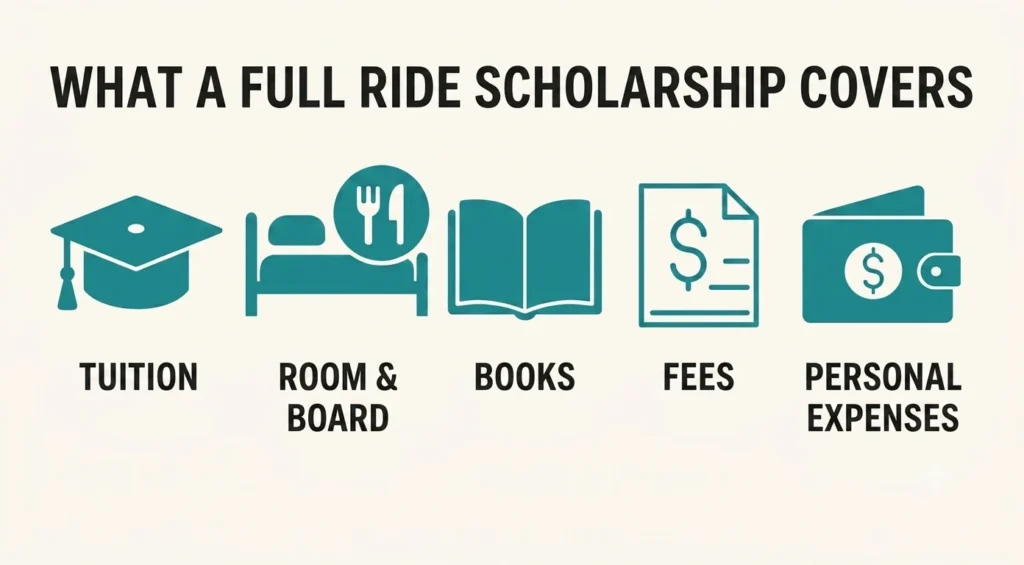
Worth clearing this up first, because people use the term loosely. A true full ride covers tuition, fees, housing, meals — sometimes books, sometimes even a stipend. Some renew automatically for four years. Others require you to hit a GPA target every year just to keep the money coming.
Here’s where families get tripped up: a “full tuition” scholarship is not the same thing as a full ride. Full tuition pays for classes. It doesn’t touch housing or food, and at a lot of private schools that gap is still $15,000 or more a year. Read the actual award letter before you celebrate.
Where This Money Actually Comes From
Four main channels, and they don’t work the same way.
Colleges hand out the most full rides themselves, usually baked into the admissions process. Vanderbilt, Duke, the University of Alabama schools like these run named merit programs that cover everything for their top applicants. State flagships do this too, particularly for strong in-state students. It’s recruiting as much as it’s generosity.
Then there are private foundations. Coca-Cola Scholars, the Elks National Foundation, QuestBridge — these tend to lean need-based or mission-driven. First-generation students, a specific career path, a particular community. Worth digging into which ones match your situation instead of applying blind to whatever pops up first in a search.
ROTC scholarships are their own category entirely. Tuition and fees, covered, in exchange for a service commitment after graduation. Not a fit for everyone, obviously, but for students who are open to it, the competition is nowhere near as brutal as it is for a merit scholarship at a top-20 school.
Athletics get overhyped. Full athletic scholarships basically live in football and men’s/women’s basketball at the Division I level — the “head-count” sports. Everywhere else, scholarship money gets split across a whole roster. A talented swimmer or soccer recruit might get a solid chunk of money. Rarely does that chunk add up to a full ride.
Grades Still Do Most of the Heavy Lifting
Nobody likes hearing this, but it’s true: academics remain the single biggest factor in most full ride decisions, especially the ones a university hands out directly.
That doesn’t mean flawless. It means consistent. A committee would rather see a B+ in AP Chemistry than an A in a watered-down science elective. They’re looking for a kid who pushed themselves, not one who played it safe for the transcript.
Standardized testing has gotten murkier since so many schools went test-optional. But “optional” doesn’t always mean irrelevant a lot of merit scholarship formulas are still built around score thresholds, even at schools that don’t require a score for general admission. Check each school’s scholarship page directly. Don’t assume. Also Read Don’t Text and Drive Scholarship: How to Win in 2026
The Essay Is Where Applicants Actually Get Separated
Once you’re in the pool for a competitive scholarship, grades stop doing anything for you. Everyone left in that pool has good grades. What separates the finalists is the essay, and sometimes an interview.
The mistake people make constantly: writing what they think sounds impressive instead of what’s actually true. Committees read thousands of essays about “overcoming adversity” and “learning the value of hard work” — vague, interchangeable, forgettable. What sticks is specific. One moment. One conversation. One weirdly small detail that makes the whole thing feel real instead of performed.
Interviews work the same way. Practice, sure, but don’t over-rehearse it into something hollow. Interviewers can smell a canned answer from across the room. They’re not grading you on polish. They want to know if you can talk honestly about your own life.
Timing Trips Up More Families Than Anything Else
This might be the single biggest reason strong students miss out — they start looking junior year, sometimes senior fall, by which point plenty of the best opportunities already needed attention months or years earlier.
Some scholarship applications open the summer before senior year even starts. Others are locked to early admission deadlines, meaning a student who applies regular decision may have already missed the scholarship review window even though the general application is technically still open.
A better approach starts sophomore or junior year, roughly like this:
– Dig into each target school’s actual scholarship page, not just the general financial aid section
– Figure out which awards need a separate application versus which ones happen automatically
– Keep every deadline in one place, because they almost never line up with regular admissions deadlines
– Ask your school counselor about local scholarships a Rotary Club, a regional bank, a community foundation
That last one gets skipped constantly, and it shouldn’t. Local scholarships draw fewer applicants, so the odds are genuinely better, and stacking several of them can get surprisingly close to a full ride even without landing one giant award.
Yes, the FAFSA Still Matters
Some families figure that if they’re going after merit money, financial aid paperwork doesn’t apply to them. That assumption can be expensive. A lot of university full ride programs require the FAFSA or CSS Profile as part of the scholarship application — even when the award itself isn’t strictly need-based. Skip it, and an otherwise strong applicant can get disqualified on a technicality that had nothing to do with their qualifications.
Worth knowing too: a handful of full ride programs are exclusively need-based. A student from a higher-income household might not qualify no matter how strong their transcript is. That’s not a loophole or a flaw it’s the whole point of those particular programs. Also Read Graduate and Professional Scholarship Program
What This Actually Looks Like in Practice
Take a student call her Maya. Solid but not flawless. 3.8 GPA, a few AP classes, active on the debate team, works part-time at a pharmacy after school. She’s not a National Merit finalist. She’s not getting recruited for anything athletic.
Maya applies to five in-state public universities that offer automatic merit consideration based on GPA and test scores. She adds three private schools known for full ride programs aimed at strong-but-not-superstar students. On top of that, two regional scholarships tied to her part-time job’s industry, plus one from a local community foundation.
She doesn’t win some flashy national award. But one in-state university offers her a full ride based purely on her academic record, and she layers a smaller regional scholarship on top for spending money. That’s a realistic version of how this usually plays out — not a single golden ticket, but smart targeting across several applications that adds up.
Where People Lose Money Without Realizing It
A few patterns show up again and again.
Applying only to reach schools with slim odds, while skipping the universities where the same grades would put them near the top of the applicant pool and eligible for automatic money.
Missing scholarship-specific deadlines because they assumed the general admission deadline covered everything. It usually doesn’t.
Recycling a generic college essay instead of writing something that actually answers what the scholarship committee is asking.
Skipping the FAFSA because the family assumes “we won’t qualify for anything,” when plenty of merit scholarships require it regardless of income.
Waiting until senior year to even start looking, when the strongest opportunities often open a full year earlier than that.
The Honest Bottom Line
Full ride scholarships don’t go to the vaguely well-rounded kid. They go to students who take their academics seriously, spread their applications across more than one dream school, never miss a deadline, and write about their own life honestly instead of performing what they think a committee wants to read.
It takes real work, and it means starting sooner than feels necessary. But it’s achievable for a lot more students than the mythology around full rides would have you believe.
Frequently Asked Questions
Do you need a perfect GPA to land a full ride scholarship?
Not even close. Committees care more about consistency in tough classes than a spotless transcript in easy ones. Ask around and you’ll find most recipients sit somewhere between 3.7 and 4.0 rarely a flawless 4.0, and that’s fine.
Can international students qualify for full ride scholarships in the U.S.?
It happens, though the field is tighter and the competition sharper. Programs like QuestBridge, along with certain university-run scholarships, do accept applicants from outside the country. Still, check the fine print on each one. Quite a few full ride programs are open only to U.S. citizens or permanent residents.
Should you go after one major national scholarship, or spread out across smaller ones?
Spread out. A student who applies to university merit programs, a few regional scholarships, and maybe one or two national competitions almost always ends up with better odds than someone betting everything on a single high-profile award. It’s not glamorous advice, but it works.
Once you’re in college, do you have to maintain a certain GPA to keep a full ride?
Usually, yes. Most renewal terms hinge on hitting a minimum GPA often somewhere between 3.0 and 3.5 — and staying enrolled full-time. A single bad semester can genuinely put the funding at risk, so it helps to know the exact terms going in rather than finding out the hard way.
Can you count on an athletic scholarship to cover everything?
Rarely, and only in a small number of sports. Full rides through athletics are mostly reserved for Division I football and basketball. Everywhere else swimming, soccer, track, you name it — coaches are usually dividing a limited pool of money across an entire roster, which means most athletes get a partial award, not a full one.