

A phone buzzes on the passenger seat. Someone glances down for a second, maybe two. That’s genuinely all it takes sometimes and it’s a big part of why a small, oddly specific pool of scholarship money now exists for students willing to write honestly about it. A don’t text and drive scholarship isn’t handed out for your GPA. It’s handed out for actually sitting with the topic instead of skimming past it.
Most students scroll right by these listings. The name sounds like something out of a school assembly, not real money for tuition. But here’s the thing the applicant pool is usually thin, the prompts are doable in an afternoon, and nobody’s asking for a 4.0 or five club memberships. Mostly you just need to write something that sounds like you actually meant it.
So let’s get into where these scholarships hide, what makes an application stand out, and how to avoid sounding like the fortieth person who typed “texting and driving is dangerous” and stopped there. Also Read Are Scholarships Taxable? Here’s What You Need to Know
Table of Contents
Why Scholarships for Safe Driving Exist
Texting behind the wheel kills people. Not in a vague, statistical-brochure way — actual people, actual families, way too often teenagers who’d only had a license for a few months. Insurance companies noticed this trend years ago. So did personal injury law firms, a handful of nonprofits, and sometimes grieving families who decided to turn something awful into a small scholarship fund instead of just a headstone.
Why funnel money into essays instead of, say, another PSA campaign? A few reasons, honestly. Peer-to-peer framing tends to land better than a parent lecturing over dinner nobody wants another lecture. Cash attached to reflection gives students an actual reason to sit down and think, rather than nodding through a fifteen-minute assembly video they’ll forget by lunch. And essay prompts are harder to fake than a signed pledge card. You can check a box without meaning it. Writing 500 honest words is trickier to phone in.
A lot of these funds trace back to something painful, if you dig into the “About” page. A family lost their teenager in a crash and decided a memorial scholarship made more sense than flowers that wilt. A law firm wanted their community outreach budget going somewhere better than another billboard nobody reads. The story behind the money varies, but there usually is one — and knowing that can shape how seriously you take your own essay. Also Read Graduate and Professional Scholarship Program
Where to Find a Don’t Text and Drive Scholarship
Don’t expect to stumble onto one through a lazy Google search. It takes a little digging, but not much.
Law Firm and Insurance Company Websites
Car accident attorneys sponsor these more than people realize it’s inexpensive goodwill, and it fits neatly into their whole brand. Check firm websites directly, especially ones based in your state that specifically handle vehicle accident cases. Insurance companies run comparable programs too, usually tied to a short essay or a video clip.
Scholarship Search Databases
Instead of just browsing general scholarship listings, type in specific phrases “distracted driving,” “safe driving,” that sort of thing. These niche searches tend to surface smaller programs that get buried underneath the big national scholarships everyone already knows about.
School Counselors and Local Nonprofits
Ask your counselor. That’s genuinely the move. Counselors often keep running lists of these obscure local awards, ones that never make it onto the major scholarship search sites. Local nonprofits focused on road safety sometimes run their own smaller programs too competition stays lighter since barely anyone knows they exist.
Social Media Campaigns
Some of these are basically built around a hashtag. Record a short clip pledging not to text and drive, post it, then pair it with a written statement. Not exactly glamorous work, but if you’re comfortable on camera, it’s an easy point of entry. Also Read Is ScholarshipOwl Legit? Here’s the Honest Truth
What Judges Are Really Looking For
Nobody sitting on a review panel for a don’t text and drive scholarship wants to read the same recycled line again “texting while driving is dangerous, don’t do it.” They’ve read that sentence a hundred times this cycle alone. What actually gets remembered is something specific, something a little uncomfortable maybe, something personal.
A real story sticks with people. Maybe you know someone who got into an accident, or you had a close call yourself once phone in hand, looked away for a second too long, and it scared you enough to actually change something. That kind of detail carries more weight than a general statistic pulled off a government website nobody clicks through to read anyway.
Vague promises fall flat too. “I’ll never text and drive again” means basically nothing on its own — everyone writes some version of that sentence. Say what you’re actually doing instead. Maybe you toss your phone in the glovebox before starting the car. Maybe you’ve got Do Not Disturb set to trigger automatically once you’re driving. Small, specific, slightly boring details read as more sincere than any grand promise.
Zooming out a little helps as well. Distracted driving doesn’t only put the driver at risk passengers, pedestrians, whoever happens to be crossing the street at exactly the wrong moment, they’re all part of the equation too. Mentioning that wider ripple shows you’ve actually sat with the topic instead of just recycling a warning label off a driver’s ed pamphlet.
And keep the writing plain, please. Skip the clichés about “learning a valuable lesson” or “changing my life forever.” Judges spot over-polished, greeting-card sentences from a mile off, and plain, slightly rough writing usually reads as more honest than anything trying too hard to sound impressive.
Sample Essay Structure
If you’re staring at a blank page, here’s roughly how a strong response tends to unfold. Start with something specific a moment, an image, something you actually remember that explains why this topic isn’t abstract to you. From there, bring in the bigger picture a little, maybe one fact about distracted driving’s impact, but don’t let the essay turn into a stat sheet; that’s not what anyone’s grading you on. Then get into what you’re actually doing about it — the real, sometimes unglamorous steps you’re taking to hold yourself accountable. And somewhere near the end, tie it back to where you’re headed next, whatever that means for you — a major, a career path, some kind of community work you’re already doing.
Tips to Strengthen Your Application
A handful of small things separate the applications that actually get read carefully from the ones skimmed in thirty seconds and forgotten.
Follow the instructions, obviously if they ask for 500 words, don’t hand in 800 just because you had more to say. Some committees toss entries automatically for ignoring format, no matter how good the writing is. Read your essay again the next day, out loud if you can manage it without feeling ridiculous, because typos and clunky phrasing jump out way more clearly that way than they do at 11pm the night it’s due. Hand it to a parent or a teacher too. A second set of eyes catches things you’ve stared at so many times you’ve stopped actually seeing them.
Apply to more than one of these if you can. Since a lot of them fly completely under the radar, competition stays low across the board, and you can usually reuse most of one solid essay with small tweaks depending on the exact prompt. Keep a saved copy somewhere so you’re not rebuilding it from nothing every single time a new one turns up.
If video’s an option and you’re not camera-shy, it’s worth trying. Tone of voice and facial expression tend to land more convincingly than a page of text, at least according to plenty of judges who’ve reviewed both formats side by side over the years.
Conclusion
A don’t text and drive scholarship won’t cover your whole degree — let’s be realistic about that. But it’s one of the more winnable options out there if you’re willing to put genuine thought into an essay instead of leaning on a stacked resume. It rewards honesty over polish, which honestly levels the field for students who don’t have five extracurriculars listed under their name.
Start with law firm websites, scholarship search tools, and a five-minute conversation with your counselor that combination covers most of what’s actually out there. Once you’ve got a program in front of you, build the essay around something true: a real moment, a specific habit you’ve built, plain language instead of a thesaurus. One solid essay, reused a handful of times with small tweaks, can end up funding more than you’d expect going in. And maybe, somewhere past the application deadline, it actually changes how you drive too.

Frequently Asked Questions
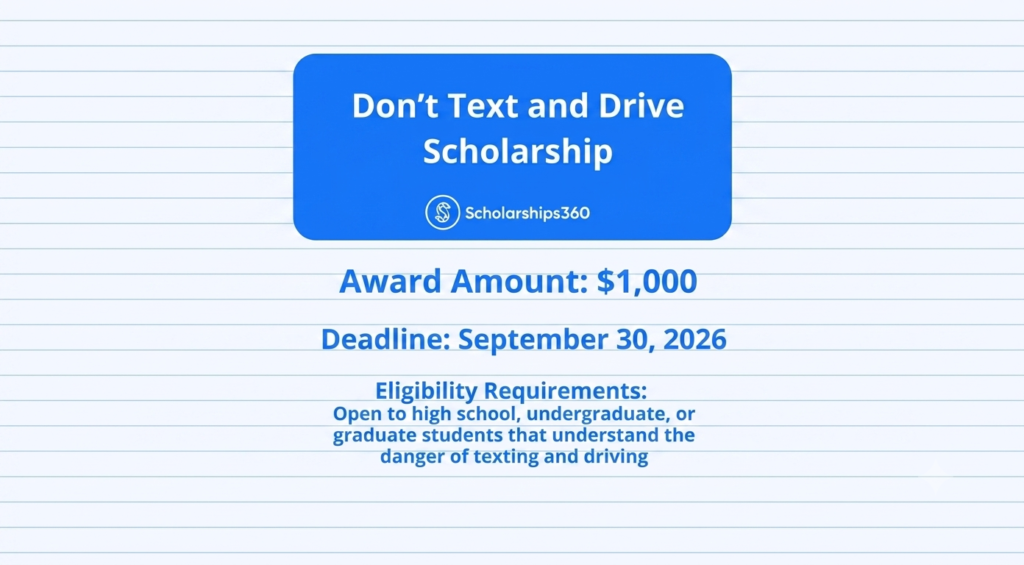
1. Who is eligible for a don’t text and drive scholarship? Depends entirely on the program. Most are open to high school seniors or college students, and some want a minimum GPA, though plenty genuinely don’t care. Read the fine print on whichever one you’re actually applying to.
2. How much money do these scholarships typically award? Anywhere from a couple hundred bucks up to a few thousand, honestly. The smaller local ones pay less, sure, but far fewer people bother applying, so the odds usually swing in your favor.
3. Do I need a personal story about texting and driving to apply? Not strictly, no. Having one helps, but plenty of strong essays are built around something a friend went through, or something the writer just witnessed once and couldn’t shake. Honest reflection matters more than a dramatic backstory.
4. Can I apply for multiple safe driving scholarships at once? Yes and honestly, you probably should. Nothing stops you from reusing a strong core essay across a handful of applications, which saves time and quietly boosts your overall odds of winning something.
5. Are video submissions better than written essays? Not better exactly, just different. Go with whichever format actually sounds like you. Forced enthusiasm on camera tends to read worse than a plainly written, honest essay, every time.